Showing posts with label Belgium. Show all posts

Thursday, 7 January 2016

Victor Horta's kitchen


Over the years, I suppose I've spent many hours in the kitchens of wherever we happened to be living at the time. It seems to have resulted in a fascination with kitchens in general but it's not often I'm sent any.

I like the look of this one, even though it's a bit empty.  When I turned the card over it stated that it was from the house of Victor Horta in Brussels (25 rue Americaine à Saint Gilles).  The name sounded familiar but I'm sorry to say, I had to look up who he was.

He was, as I'm sure everyone else knows, a famous architect of Art Nouveau houses in Belgium. Four of these houses, plus his own, are listed as World Heritage Sites by UNESCO as being prime examples of Art Nouveau.

Sunday, 19 July 2015

Butterflies


I would have sworn I had shown these butterfly stamp cards before, but if I did, then I can't find them.  The first is from a recent series, "British Butterflies" issued in 2013, and the second from a series also called "British Butterflies" issued in 1981.

And here is a stamp that arrived just this week, from Belgium, just to make a change from the PHQ stamp cards.


This is a post for Sunday Stamps, hosted by Violet Sky at "See it on a Postcard!"

Saturday, 21 February 2015

Onze Lieve Vrouw kerk in Laken, Brussels


I studied this card carefully because I thought there must be some sort of optical illusion going on, or could there really be a road passing underneath the church?  In fact, after much searching, I found out that there is an underpass but it comes to the surface well before the church.

The church in question is Onze Lieve Vrouw in Laken, Brussels, known for the Royal Crypt and its beautiful cemetery.

Sunday, 30 November 2014

Christmas postcards and stamps


I bought several sets of these Royal Mail PHQ Christmas postcards a few years ago and now I'm down to one remaining set.  I'll use them up over the nest few weeks but I'll be sorry to see them go.  They show the images for the 1983 Christmas stamps:

12½p Christmas Post (pillar-box),
16p The Three Kings (chimneys )
20½ World at Peace (a dove and a blackbird)
28p Light of Christmas (street lamp)
31p Christmas Dove (topiary)

As I was looking up what the images represented, I discovered that someone is selling them on Zazzle. Surely that's a copyright issue?

That aside, I found plenty of other bird stamps:

Belarussian stamp with great egret

Great Egret from Belarus


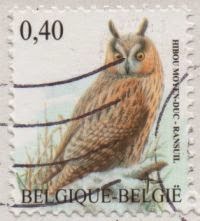
Belgian stamp showing long-eared owl

Long-eared owl on Belgian stamp


From the Netherlands 


Siberian Crane on stamp from Russia


and a cute little owl from Switzerland.


This is a post for Sunday Stamps, now hosted by Violet Sky at "See it on a Postcard!"

Friday, 21 November 2014

Young roe deer


I travel home tomorrow, so I hope to post more regularly and with a little more to say for myself. The postcsrd showing the young deer came from Belgium.

Wednesday, 9 July 2014

Gargoyles


The first time I imported this image I had it rotated so that all the gargoyles were sitting up.  They looked a lot more comfortable that way until I realised they wouldn't appear like that on the building, in this case the Hotel de Ville in Brussels, Belgium.  And the second clue was the position of the name "BRUSSELS".  I must be a bit slow today.

The Hotel de Ville is on the Grand Place which is listed as a UNESCO World Heritage Site.

Sunday, 23 February 2014

Hearts without flowers...

...and flowers without hearts.
I found this theme incredibly difficult.  All I could find were hearts without flowers and flowers without hearts., and none were anything to do with romance or Valentine's Day.  Here are my slim pickings:


By happy coincidence, a card with hearts on was sent from Belgium with a flower stamp but if you examine the postmark you will see it was sent in August, so nothing at all to do with Valentine's Day.


A card from Thailand has a heart shaped stamp.  The little hearts around the edge of the stamp are gold and shine.  No flowers in sight so here are a couple of flowery stamps from other countries:


Sweet peas are one of my favourite flowers.  I don't know the South African flower but it's an attractive stamp.


This is a post for Sunday Stamps, now hosted by Violet Sky at "See it on a Postcard!"

Saturday, 26 October 2013

Processions

I have absolutely no idea where this next series of cards came from.  I was sorting (and resorting, as you do) my boxes of cards last night and came across a set, all vintage and all showing processions of some sort or another.  I think they must have belonged to my father.

I realised too late that this one would fit quite nicely with last week's Sepia Saturday theme.  Too late for last week but I'm posting it anyway to celebrate this week, the 200th week since the formation of Sepia Saturday.


At first glance I thought it could possibly be a Robin Hood enactment but that's as far as it goes.  There is no further information anywhere.  The back is very plain and according to Playle's it is from an unknown British publisher between 1915 and 1918.


With ii was another form of precession but this time a painting called A Pageant of Childhood by Thomas Cooper Gotch, a book illustrator and painter in the pre-Raphaelite style.


This one is used and dated 1910.

Finally, for this post, there were several illustrating the Procession of the Holy Blood (Processie van het Heilige Bloed/Procession du St Sang) in Bruges, Belgium.


This is an annual Ascension Day procession in Bruges which re-enacts both biblical stories and historical scenes.  It was placed on UNESCO's List of Intangible Cultural Heritage in 2009.

There were other processions, among them one showing the Godiva procession in Coventry.  Suddenly I see a whole new theme for collecting...
Enhanced by Zemanta

Sunday, 11 November 2012

Remembrance 2012


In many countries around the world, 11 November is the day on which we remember the members of the armed forces who have given their lives in the line of duty.  The date, 11 November, commemorates the date on which the armistice was signed at Versailles, to mark the end of the First World War.

The top postcard I bought earlier this year when I visited the WWI sites in northern France and Belgium. It shows Tyne Cot Cemetery, the largest Commonwealth War Cemetery in the world, having almost 12,000 graves, many of which are unidentified.  It is in Belgium near Passendale. The name comes from the nickname given to a barn on the Passchendaele-Broodseinde road later captured by 3rd Australian Division.

The second postcard shows the Menin Gate in Ypres or Ieper in Belgium.  I did visit this too but the card was sent in 2005.  The Menin Gate is a memorial to British and Commonwealth soldiers whose graves are unknown.  There are 54,896 names on this memorial.  They ran out of space so the remaining names, another 34,984 of them, are inscribed on the wall at Tyne Cot.  Looking at the names, row after row of them filling the walls, brings home the full horror of war.

Each evening at 8:00 pm, the Last Post is sounded at the Gate.

1995

1975

2005

Three stamps, the first Belgian and the others both French, commemorate the Second World War liberation of concentration camps.  I'm not sure I care for the style of the third which looks slightly cartoon like and seems unsuitable for such a subject.

This is a post for Sunday Stamps, now hosted by Violet Sky at "See it on a Postcard!"

Friday, 17 August 2012

Carpet of flowers


Every second year a Flower Carpet is laid out in the main square, the Grand-Place, in Brussels.  It is made up of 750,000 begonias, each time in a different design.  The one pictured here was displayed in 2010 to commemorate the Belgian presidency of the European Union.

It may seem a lot of begonias but Belgium produces 60 million each year, the largest producers in the world. Their biggest customers are the Netherlands, France, and the USA.

This year's display, for five days, will finish on Sunday.  Read all about it.

Apart from the carpet, the Grand-Place is a protected site, a UNESCO World Heritage Site, because of the surrounding architecture.  Years ago I had to go to Brussels for work and made a point of visiting the square for a cup of coffee sitting enjoying the atmosphere.  It was a very expensive atmosphere, as I recall.

This is a post for Postcard Friendship Friday hosted on Beth Niquette's blog The Best Hearts are Crunchy.

Wednesday, 1 February 2012

A subtle form of cruelty


Belgian chocolates from Belgium.  I can taste them now.  Sigh.
Enhanced by Zemanta

Wednesday, 4 January 2012

Donjon Carondelet


Is it a fortified house, is it a keep, is it a castle?  I'm never sure of the different definitions though it is without a doubt old and beautiful.  It may have been built as early as the 11th or 12th century although wasn't actually mentioned in documents until the 14th.   It is private property and can't be visited by the public.  We can admire it from here all the same.

It is in a little village called Crupet in Wallonie, Belgium, and listed on the website, The Most Beautiful Villages of Wallonia which is part of a network of similar sites also in Italy and France.  I've often visited similar villages in France and they are always a delight.

This card was sent to me by Gerda, from My Postcard Page.  Thank you, Gerda!
Enhanced by Zemanta

Friday, 18 November 2011

Tintin's travels


The Adventures of Tintin were written by Hergé, a Belgian artist otherwise known as Georges Remi.  There were 23 books in the series between 1929 and 1976, and they have been translated into over 80 languages.

Tintin's adventures as a young reporter took him to many countries in Europe, Africa, North and South America, Australia, and as shown on this postcard, Asia.  There were a few fictional settings too.  This is probably the most unusual map I've ever received.

This is a post for Postcard Friendship Friday hosted on Beth Niquette's blog The Best Hearts are Crunchy.

Friday, 28 October 2011

A young couple


I imagine this must be a picture to mark a First Communion.  It is one of the many pictures taken by Belgian photographer, Norbert Ghisoland.  He was a miner's son, born in Frameries in 1878, who went on to become an "accidental anthropologist" by recording the social history of the time.

At one time studio photography was expensive enough to restrict it to the wealthy but techniques improved to reduce the costs and opened up opportunities to those of more modest means.  Ghisoland's aim was only to provide his clients with the pictures they wanted but the 45,000 (about half the number he originally took) of his negatives have left a great record of the times.

These pictures, found accidentally in the family attic by Ghisoland's grandson, have been the subject of several exhibitions in Belgium and around the world.

This is a post for Postcard Friendship Friday hosted on Beth Niquette's blog The Best Hearts are Crunchy.

Tuesday, 23 August 2011

Fool's Cap


The Fool's Cap Map of the World.  It is thought to be flemish in origin and possibly from Antwerp, dated about. 1590 The official description is: A fool or jester with a world map in place of his face. World map on the cordiform projection, within the visor of a fool's cap.  Cordiform apparently means heart-shaped.

It makes me wonder why foolscap paper is so called. The answer, according to Wikipedia, is "Foolscap was named after the fool's caps and bells watermark commonly used from the fifteenth century onwards on paper of these dimensions".

The card was sent to me from the USA but the card was published by the British Library.
Enhanced by Zemanta

Monday, 18 July 2011

They tell me it's summer


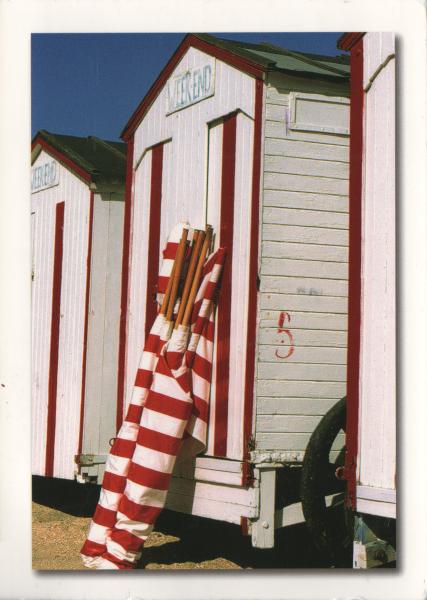
Beach huts mean it's summer.  Unfortunately it's hard to tell otherwise.  They've stopped talking about drought, so that's a bonus.

Tuesday, 31 May 2011

For the love of libraries


Biblioteca Marucelliana, Florence, Italy
The student has his Rome, his Florence, his whole glowing Italy, within the four walls of hos library.  He has in his books the ruins of an antique world, and the glories of a modern one. ~ Henry Wadsworth Longfellow.
The library was first opened to the public in 1752, purpose built to accommodate the collection of Abbott Francesco.  The shelving in the Reading Room was built at the same time as the building and so dates from the mid 18th century.  It is one of five historical libraries in Florence.  Since 1910, it has been the recipient of all printed works from Florence and the surrounding area.


I can't decide whether I'd enjoy working and studying in such an atmospheric place or whether the close proximity of other people shuffling paper would be a hindrance.  I'd love to have the opportunity to try.
Enhanced by Zemanta

Saturday, 2 April 2011

Palais de la Dynastie

The Palais de la Dynastie, also known as the Musée de la Dynastie, is in the Royal Quarter of Brussels.  This clock  above the archway is a 24 bell carillon.  The dial is decorated with 12 figures representing important people from history or folklore.  These figures move when the figure high above strikes the bell each hour. 

It is a Jacquemart clock or bellstriker clock.  The oldest known Jacquemart clock is in Dijon, France but there are many examples.  All have a human-like figure which moves, striking a bell to tell the time.
Enhanced by Zemanta

Thursday, 24 March 2011

The Island, Antwerp


Het Eilandje twijfelt tusses land en water - Rijnkaai
The Island suspended between land and water - Rijnkaai
The old cranes in the former port of Antwerp on the river Schelde.  Now there's a huge container port further downstream, leaving behind these cranes, looking remarkably like metallic giraffes.

Monday, 27 September 2010

Ghent


The story of these buildings is as interesting as the Ghent Museum of Folklore that they house.  They were built in the 14th century as the result of a feud between two families.  The feud was so intense that two children of the Alijn family had been murdered by members of the Rijm family.  The murderers were eventually pardoned on condition that they built almshouses for the poor and needy.

Six hundred years and some renovation later, the building became home to the Folklore Museum and called the House of Alijn, Het Huis van Alijn.  Inside it has rooms reconstructed to give a glimpse of life in different periods, from the Middle Ages to the early 20th century.

Enhanced by Zemanta
Related Posts Plugin for WordPress, Blogger...