Showing posts with label Switzerland. Show all posts

Wednesday, 22 April 2015

S is for Swiss tradition and for Silvesterkläuse

and possibly also for Strange...


... but they are, at least, unique.  You can find these creatures in a small area in the north east of Switzerland, Apenzell, and only on the dates of 31 December and 13 Janyary.  Rare indeed.

People, men usually because the costumes are heavy, dress up and wander from house to house, wishing people a happy new year.  There are three different types of costume: "Schöne" (meaning beautiful), "Schö-Wüeschte" (meaning pretty ugly) and the "Wüeschte" (meaning ugly).

The Schöne wear costumes similar to traditional Swiss costumes while the Wüeschte two varieties use natural material - twigs, leaves and moss.  All have bells front and back, and they all wear masks. The beautiful have pretty masks, the fairly ugly have masks of natural materials and the ugly have scary masks.  It's hard to say which variety of ugly they are in the picture.

Tuesday, 17 February 2015

St Ursanne, Switzerland

Medieval bridge over river to old town houses

Saint Ursanne is exactly the sort of place I'd love to visit. It's in the Jura canton of Switzerland, almost in France.  Although France also has a Jura département, it is Doubs which adjoins the Jura Canton.

St  Ursanne is a medieval village with an old abbey and outstanding cloister.  The houses date from the 14th to 16th century.  It owes its name to an Irish monk, Ursan, whose hermitage can be visited if you wish to climb the 180 steps up to its cave.


Sunday, 30 November 2014

Christmas postcards and stamps


I bought several sets of these Royal Mail PHQ Christmas postcards a few years ago and now I'm down to one remaining set.  I'll use them up over the nest few weeks but I'll be sorry to see them go.  They show the images for the 1983 Christmas stamps:

12½p Christmas Post (pillar-box),
16p The Three Kings (chimneys )
20½ World at Peace (a dove and a blackbird)
28p Light of Christmas (street lamp)
31p Christmas Dove (topiary)

As I was looking up what the images represented, I discovered that someone is selling them on Zazzle. Surely that's a copyright issue?

That aside, I found plenty of other bird stamps:

Belarussian stamp with great egret

Great Egret from Belarus


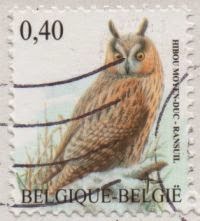
Belgian stamp showing long-eared owl

Long-eared owl on Belgian stamp


From the Netherlands 


Siberian Crane on stamp from Russia


and a cute little owl from Switzerland.


This is a post for Sunday Stamps, now hosted by Violet Sky at "See it on a Postcard!"

Saturday, 15 March 2014

Arches and domes


The Galleria Vittorio Emanuele in the centre of Milan is four storeys high, two arcades each with a glass vaulted roof.  Where the two arcades meet, they form an octagonal glass dome.  The Galleria took 12 years to build, from 1865 to 1877, but the card is more recent, probably 1915-1920.  Nowadays the shops sell luxury goods, plus some cafes and restaurants.  McDonalds had been one of the tenants for 20 years but the city of Milan refused to renew its tenancy in 2012.


While on the subject of arches and places to buy things, here is a card from Lugano in Switzerland, the Portici (arcades) di Via Pessina.  Again these date from the 19th century.  Nowadays the road is entirely pedestrianised and the shops sell mainly crafts, jewellery, and delicatessen foodstuffs.

This is a post for Sepia Saturday.  A click on the button will take you to the site.


Enhanced by Zemanta

Monday, 27 January 2014

Maps on Monday - Switzerland


Three postcards showing the map of Switzerland.  The first one dates from 1906 and was posted in Zurich, the second one has a Luzern postmark, dated 1909, while the third is modern and unposted.  The vintage cards have the coats of arms of the cantons embossed on the card.

The maps remain remarkably similar over the years shown on these cards, unlike many European countries.  The cantons were once individual sovereign states now joined together in a confederacy.  The cantons have their own constitution, laws and government, and they don't all have the same official language.  There are four official languages in Switzerland as a whole: German, French, Italian and Romansh.

The CH abbreviation for Switzerland comes from the Latin name, Confoederatio Helvetica.
Enhanced by Zemanta

Thursday, 21 February 2013

Lucerne and the lake


Lucerne or Luzern towards the north of Swizerland lies on the side of Lake Lucerne (or Vierwaldstättersee in German).  One of its main attractions is the wooden Chapel Bridge and water tower shown on this poster from 1936. Sadly the bridge was almost burnt down in 1993 though it has since been restored, but many the original interior painting were destroyed.  There used to be three of these pedestrian bridges but only two remain, this and the Spreuerbrücke.  All had 17th century paintings in the triangles formed by the roof trusses.

The poster has been reproduced as a very attractive postcard by the Museum für Gestaltung, the Museum of Design, in Zurich.
Enhanced by Zemanta

Wednesday, 7 December 2011

Swiss cows


Mountaineering cows?  Gymnast cows?  I don't know what cows do in Switzerland.  Whatever they are, they make me smile.
Enhanced by Zemanta

Monday, 3 October 2011

Le Berceau de la Confédération


Le Berceau de la Confédération (Cradle of the Confederation) was painted by Charles Giron in 1901 and hangs in the Federal Palace in Berne.  I hadn't realised, until I looked it up, that it's a mural and enormous.  It measures 11.5 metres by 5 meters (38 feet by 16).


I think this picture from Wikipedia gives a better idea of the size because it shows the setting.  The scene is Lake Uri, part of Lake Lucerne.  In the high resolution picture you can see a fish on the topmost ledge on the left which the artist painted as an April Fool's joke because the parliament building opened on 1 April.  He also painted the clouds as a naked woman with an olive branch to symbolise peace, but I don't see that at all.
Enhanced by Zemanta

Thursday, 15 September 2011

Grande Dixence dam


Who would have thought the subject of dams could be interesting?  This, the Grande Dixence, is the highest gravity dam in the world, in the south west of Switzerland at the head of the Val de Dix.  It is 285 metres (935 ft) high with a triangular cross section.  This apparently is what makes it a gravity dam.  Other possible types of dam are arch, buttress, or embankment dams, but Grande Dixence is a gravity dam.

The dam collects the water from 35 glaciers in the area as they melt in the summer and then it's used to drive the turbines in two power stations.  The power produced is enough for 400,000 households.

It's possible to do tours of of the dam itself, and of the pumping stations.  There is a bar and hotel at the base of the dam where you can even arrange to be married.  They seem to cater for every possible occasion.
Enhanced by Zemanta

Tuesday, 5 July 2011

Milka cows


Lisl, Resi and Frida are Milka cows and provide the milk which goes into Milka Swiss chocolate.  They should be treasured for for everyone knows that Swiss chocolate is the best in the world.  Milka, the tenderest temptation since chocolate was invented (it says).

Sunday, 3 July 2011

An Irish hermit and a library


Once upon a time (in the 6th century) an Irish man called Columbanus left Ireland because his exceptional good looks meant he was struggling not to be led astray by women.  He set off with twelve companions first for Britain and then for mainland Europe.

One of these companions was Gall who stayed behind in present day Switzerland when he fell ill. He recovered and established a hermitage which was eventually to become the Abbey of St Gall.  The Abbey has existed since 719.  For centuries it was one of the most important abbeys in Europe.

Irish and Anglo Saxon monks came to copy manuscripts which were the foundation of its library, one of the richest medieval libraries in the world.  There are over 400 manuscripts surviving from the early days and are over 1000 years old.  During the 10th century some of the books were removed for safe-keeping when the Abbey was threatened and not all were returned.  A little later a fire almost destroyed the abbey but the library fortunately survived.


There are now 160,000 books in the library at the Abbey of St Gall, of which 2,100 are hand-written.  Recently the Abbey has started to digitise the manuscripts to provide online access to them.  So far there are 405 available on the Codices Electronici Sangallenses (Digital Abbey Library of St. Gallen) web page.

The "real" library is open to the public and is visited by both tourists and researchers from all over the world.
Enhanced by Zemanta

Sunday, 3 April 2011

Optical illusion


I did a double take when I turned this card over and discovered the Royal Mail post boxes hadn't been sent from Britain at all, but from Switzerland.  And then I could hardly take my eyes off the stamps.


Even after scanning, I think you can see the illusion of twirling in the first, and in the second the ball seems to float.  I believe there were others in the set but I don't have them.

This is a post for Sunday Stamps, now hosted by Violet Sky at "See it on a Postcard!"

Tuesday, 15 February 2011

The last of the snow


I imagine this village had a bumper year as far as snow is concerned this last winter.  It is Veysonnaz in Switzerland, and is best known for winter sports.  It's part of one of the largest ski resorts in the Alps, Les 4 Vallées, covering Verbier , Nendaz , Thyon and Tzoumaz as well as Veysonnaz.  The idea of connecting all these resorts into one was first conceived in 1970 but didn't become reality until 1983.
Enhanced by Zemanta

Wednesday, 16 December 2009

Morgins


This was sent to friends of my parents and obviously donated to the cause.  It is postmarked from Troistorrents and dated 2 December 2009.

Morgins is opening some of its ski runs today, 16 December 2009.  It is situated in the Troistorrents commune which gets its name, not from three torrents or waterfalls, but from Roman colonists who called it Trans torrentium, beyond the torrent.

Wednesday, 11 March 2009

Winterthur, Switzerland


Postmarked Zurich, dated 5 March 2009.
Stadtkirche Winterthur
Grosse Orgel, Walker 1888
Restauriert: Kuhn 1980-84
Photo Thomas Kunz

The stunning baroque organ inside the Stadtkirche, town church, of Winterthur.  Equally impressive are the wall paintings by the Bernese painter Paul Zehnder.  The person who sent it to me is a music student, of organ music in particular and plays this organ.  What a privilege that must be!

Tuesday, 23 December 2008

Pontresina, Switzerland


Postmarked Pontresina, dated 22 December 1974.

Pontresina (1828 m) Kirche Sta. Maria
Blick gegen Piz Saluver und Piz Nair.

The village is high in the Engadine region of south east Switzerland, often overlooked in favour of nearby St Moritz.
Enhanced by Zemanta

Monday, 22 September 2008

Aarau, Switzerland


Postmarked Aarau, dated 12 September 2008.

The town of Aarau is situated on the Aare river. It was for a short time the capital of Switzerland and home to the first Swiss Houses of Parliament. It is well known for the painted gables, called Dachhimmel, on the buildings (bottom left). The Upper Gate Tower (bottom right) and one or two other buildings are all that remain relatively unchanged from the medieval period. During the 16th century most were replaced or expanded.Reblog this post [with Zemanta]

Monday, 25 August 2008

Jungfrau


Never posted. Bought January 1992.

Schweiz/Suisse/Svizzera/Switzerland
Jungfrau 4158 m im Abendrot
(Berner Oberland)

The Jungfrau in a red evening sunset.

The Jungfrau is the highest peak in the Berner Oberland region of the Swiss Alps. It now has a railway running inside it, the Jungfraubahn cog railway, which goes to the highest railway station in Europe, the Junfraujoch.

This card was bought by my younger son when he went on a school ski trip. We were in Paris at the time. I had to get him to school by 6:00 am, return home, leave the car there and catch a bus to the Métro, go to the Gare du Nord and catch a train to Calais. Cross to Dover and catch a train to London, then another to Southampton in time to see my older son swim in some important competition that evening. I can't remember the reasoning behind the logistics, but it must have been the only way I could get there in time - it was pre- cheap flights, and pre-TGV. All I can remember is complete and utter exhaustion.
Reblog this post [with Zemanta]
Related Posts Plugin for WordPress, Blogger...