Showing posts with label A-Z. Show all posts
Monday, 4 May 2015
Reflections
St Front Cathedral in Périgueux, France can trace its origins back as far as a church built on that site in the 4th and 5th centuries. In 976 the Abbey of St Front was built on the site of the church and it became a cathedral in 1669. It was rebuilt in the mid 19th century and only the bell tower and crypts are left of the 12th century building.
The significance of St Front lies with the fact that it was and still is an important stopping point for pilgrims following the Routes of Santiago de Compostela (Chemins de Saint-Jacques-de-Compostelle) through France. These routes are recognised as of World Heritage importance by UNESCO.
So, the A to Z Challenge has come to an end. I managed to keep ahead of the schedule though I nearly lost it when I had to be away for some days. The intention was to kick-start my blogging which had sadly lapsed. I hope I can keep up some of the impetus.
I found trawling through the list for blogs was very time consuming. I did have difficulty commenting on a lot of them, especially having to sign in to Disqus, Wordpress, Google+, and there were quite a few who hadn't updated though I noticed a lot were weeded out.
But, all in all, it was an enjoyable experience, though I doubt I will be repeating it.
My posts, in order of appearance
A is for Amsersfoort
B is for Biarritz and also for Bertie
C is for Czech Republic
D is for Dunes
E is for Estonia
F is for the Forth Bridge
G is for Green Giant
H is for Hollywood, Houston and Honeymoon Island
I is for Irkutsk
J is for Japan
K is for Korea
L is for Reading
M is for Mulu National Park and Malaysia
N is for Nürnberg or Nuremberg
O is for Ottawa and Ontario
P is for Potelych
Q is for the Queen
R is for Riquewihr
S is for Swiss tradition and for Silvesterkläuse
T is for Tango
U is for Ulm
V is for Vintage
W is for World
X is for Xinjiang
Y is for Yin and for Yang
Z is for Zulu
Labels:
A-Z,
cathedral,
France,
night view,
river-canal,
UNESCO
Location:
Périgueux, France
Thursday, 30 April 2015
Z is for Zulu
The Kingdom of Zulu lay in what is now known as KwaZulu Natal in South Africa. It grew from a small area around what is now Bulawayo to occupy much of the south eastern coastline of the present day South Africa.
The Zulu people are the largest ethnic group in South Africa and the Zulu language is an official South African language and the most widely spoken.
And so ends the A to Z challenge for 2015. In the end, it wasn't as hectic as I had anticipated, although having had to be away from home for 10 days recently hasn't helped. I will be spending much of tomorrow trying to catch up on visits.
Thank you to everyone who has paid a visit to me and to everyone who left a comment. All very much appreciated.
Labels:
A-Z,
South Africa,
tradition
Location:
KwaZulu-Natal, South Africa
Wednesday, 29 April 2015
Y is for Yin and for Yang
For years and years I've looked at versions of this illustration and called it a symbol for yin and yang, and, yes, in a way it is. However on the card, if you can decipher the writing, it says it is Taiji, a complex philosophical perm meaning the Supreme Ultimate.
To add to the confusion, if you like, in the west we tend to use the word Taiji (or T'ai Chi) to describe the martial art which should more correctly be called Taijiquan (or T'ai chi ch'uan), or Supreme Ultimate Fist.
Yin and yang come into it because they demonstrate how apparent opposites can in fact be complementary and depend on each other. This is central to the principles of Taijiquan where students are taught to meet brute force with softness.
The wording on the card has been taken almost directly from Wikipedia. The card is one published by an on-line company, taobao.com, popular in China.
Location:
China
Tuesday, 28 April 2015
X is for Xinjiang
Xinjiang is a province in the north west of China, close to Mongolia and Kazhakstan. It contains the Tianshan mountains which were added to the UNESCO World Heritage list in 2013 because of their untouched beauty and contrasts, along with being the habitat for a number of rare and endangered species of flora and fauna.
The caption on the reverse of the card reads, "The Spring of Tianshan Mountains - Zhaosu Army Horse Breeding Farm". It is one of the most beautiful cards I have ever received, very large though at 23 x 11.5 cm (9 x 4.5 in) and difficult to store safely.
Location:
Xinjiang, China
Monday, 27 April 2015
W is for World
There are some very unusual maps of the world, such as Heinrich Bünting's "clover leaf" map but these two are more or less what we might expect a map of the world to look like, in spite of being very different.
The top postcard came from Lithuania and was published there. It is a reproduction of a map drawn in 1886 showing the extent of the British Empire. The inset shows the extent of the empire in 1786.
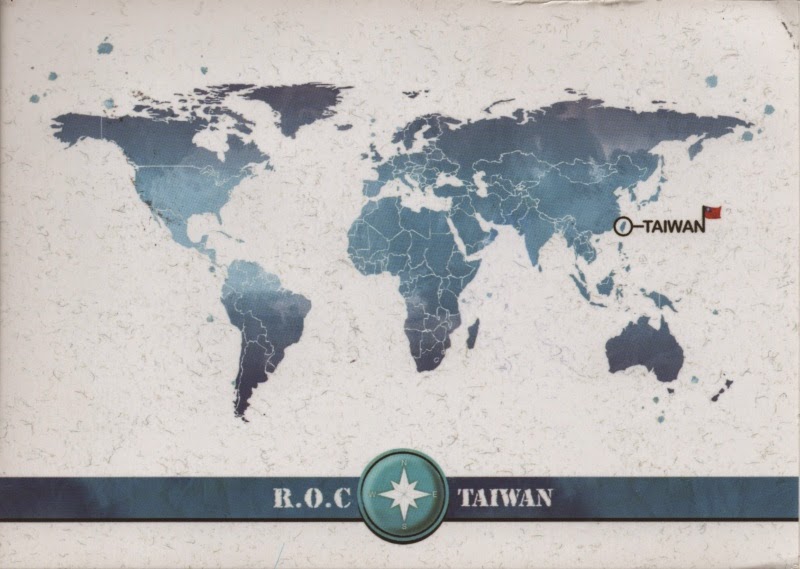
The lower map is one, as you can see, from Taiwan, much simpler and less ornate.
Although I have a very large number of maps, they usually show individual countries or regions, much less often the whole world.
Saturday, 25 April 2015
V is for Vintage
Most of my modern cards, in fact almost all of them, have been collected through Postcrossing, but I also have a large number of vintage cards which I have bought in various places such as postcard fairs or eBay.
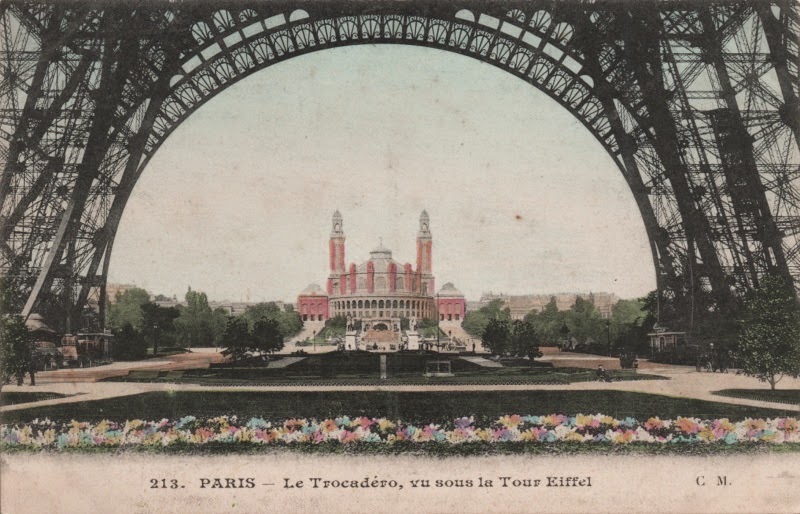
For a time we lived in Paris so I look out for postcards from the area. There are just so many cards of Paris that I don't often buy them but these three caught my eye for different reasons.
The top one, dated on the back August 1919, shows an aerial view of what is now called Place Charles de Gaulle but was then Place de l'Étoile. The photo was taken from a balloon at 700 metres. I used to dread having to drive around the Arc de Triomphe.
The second also shows a view from 1919 but was written a year later because the message says "This is also a street in Paris which was flooded last January". My sons were at a school on the banks of the Seine, and even then it did rise dangerously high from time to time.
The third caught my eye for being an attractively framed picture, something that isn't always the case with vintage cards. One of my sons had a friend who lived nearby but it looked very different by then.
Location:
Paris, France
Friday, 24 April 2015
U is for Ulm
Ulm, in the south of Germany, was once a Free Imperial City of the Holy Roman Empire but much of its historic centre was destroyed during World War II. Some of the buildings, but by no means all, have been restored.
The postcard shows the modern library with the backdrop of the Butcher's Tower (Metzgerturm) and the Danube beyond. The tower leans by over 3 degrees. Legend has it that it was caused by overweight butchers cowering in a corner when the angry mayor came to punish them for selling low quality meat.
Labels:
A-Z,
Books/reading/libraries,
Germany,
river-canal
Location:
Ulm, Germany
Thursday, 23 April 2015
T is for Tango
This card is probably self-explanatory to some extent. It's one of very few I've received t=from Argentina but it's quite special because the tango, the dance, has been declared by UNESCO to be "a living treasure" and it was added to the List of the Intangible Cultural Heritage of Humanity in 2009.
Location:
Argentina
Wednesday, 22 April 2015
S is for Swiss tradition and for Silvesterkläuse
and possibly also for Strange...
... but they are, at least, unique. You can find these creatures in a small area in the north east of Switzerland, Apenzell, and only on the dates of 31 December and 13 Janyary. Rare indeed.
People, men usually because the costumes are heavy, dress up and wander from house to house, wishing people a happy new year. There are three different types of costume: "Schöne" (meaning beautiful), "Schö-Wüeschte" (meaning pretty ugly) and the "Wüeschte" (meaning ugly).
The Schöne wear costumes similar to traditional Swiss costumes while the Wüeschte two varieties use natural material - twigs, leaves and moss. All have bells front and back, and they all wear masks. The beautiful have pretty masks, the fairly ugly have masks of natural materials and the ugly have scary masks. It's hard to say which variety of ugly they are in the picture.
... but they are, at least, unique. You can find these creatures in a small area in the north east of Switzerland, Apenzell, and only on the dates of 31 December and 13 Janyary. Rare indeed.
People, men usually because the costumes are heavy, dress up and wander from house to house, wishing people a happy new year. There are three different types of costume: "Schöne" (meaning beautiful), "Schö-Wüeschte" (meaning pretty ugly) and the "Wüeschte" (meaning ugly).
The Schöne wear costumes similar to traditional Swiss costumes while the Wüeschte two varieties use natural material - twigs, leaves and moss. All have bells front and back, and they all wear masks. The beautiful have pretty masks, the fairly ugly have masks of natural materials and the ugly have scary masks. It's hard to say which variety of ugly they are in the picture.
Labels:
A-Z,
Switzerland,
tradition
Location:
Appenzell District, Switzerland
Tuesday, 21 April 2015
R is for Riquewihr
Riquewihr is a small, very picturesque, medieval town in the north east of France, in the Alsace region. The tower shown is the Dolder Tower, one of the entrances to the town.
Its current population is less than it was in 1793. This is the fate of so many small towns in France. There is no work there. Fortunately this one has the advantage of being so picturesque and has been described as one of the most beautiful villages in France.
Les Plus Beaux Villages de France is an independent organisation which lists many beautiful small towns and villages. I haven't seen Riquewihr but I've seen several others: Collonges la Rouge, Saint Benoît du Sault, Séguret, to name a few. They live almost entirely on tourism. It gives the place a very strange atmosphere, especially if you visit off season when they can seem like ghost towns.
Location:
Riquewihr, France
Monday, 20 April 2015
Q is for the Queen
One of the most requested themes wished for by postcard collectors who are members of Postcrossing is that of royalty, so I find myself sending out postcards of the Queen quite frequently. I rapidly became bored with the variety, or lack of it, of any pictures of the royal family I can buy in shops, so I bought a book of postcards from the National Portrait Gallery, "The Queen in Art and Image".
I have been pleased with the range of portraits even though some are really quite strange. These two are among my favourites in the book, showing a less formal view of the Queen. The first is a photo taken in 1968 (no location given), the second in 2007, at the opening of the Lawn Tennis Association's headquarters in Roehampton. You can tell it's a typical British summer when it rains for tennis.
Location:
Roehampton, London SW15, UK
Saturday, 18 April 2015
P is for Potelych
A picture of a different side of Ukraine, different from the terrible pictures we have been treated to in the news. It shows a wooden church dating from 1502, the Church of the Descent of the Holy Spirit.
There are 16 of these wooden tserkvas (churches) in the area known as the Carpathian Region which stretches over Poland and Ukraine. They all have the very distinctive building style, made entirely of wood.
Seven of the churches are in Ukraine but the person who sent me the card says she has never actually seen any of them. They tend to be in remote places and not too easy to visit.
Location:
Potelych, Lviv Oblast, Ukraine
Friday, 17 April 2015
O is for Ottawa and Ontario
The Rideau Canal was built in 1832 as a military communications route from Ottawa to Lake Ontario. Nowadays it is used for recreation but it remains an exceptional feat of engineering. It is the oldest canal system in North America which still functions.
This particular card shows an image of kayaks, on the canal in Ottawa, that was used as a postage stamp by Canada Post. Others stamps were issued to show skating on the canal in winter, and Jones Falls. I don't have the Jones Falls stamp card but I do have others of that area.
The canal in its entirety was added to the UNESCO list of World heritage Sites in 2007.
Labels:
A-Z,
Canada,
river-canal,
UNESCO
Location:
Ottawa, ON, Canada
Thursday, 16 April 2015
N is for Nürnberg or Nuremberg
It's hard to write anything about Nuremberg without starting on a lengthy essay, if not a dissertation. I'll be brief.
It's a beautiful and very old city, towards the south east of Germany, dating back to 1050, or even earlier. That is, at least, the date of the first documented mention of the city. It was considered for a time to be the unofficial capital of the Holy Roman Empire, partly because of the general assemblies and courts held in the castle which you can see on the horizon in the picture.
The postcard shows signs of damage from the post office sorting machines. This type of damage leads a lot of people to collect only unused postcards but for myself, I prefer them to show signs of their travels, within reason of course. I also like to have the postmark on the back, for dating purposes if nothing else.
Location:
Nuremberg, Germany
Wednesday, 15 April 2015
M is for Mulu National Park and Malaysia
Mulu National Park is yet another UNESCO World Heritage Site, this time in Sarawak, Malaysia. It's best known for its enormous caves, and also for these amazing pinnacles and cliffs.
The Mulu Caves Project started in 1977 when the Royal Geographical Society sent 100 scientists there for over a year. Since then, there have been more than 20 others which you can read about on the Mulu Caves website - there are some amazing pictures there!
Tuesday, 14 April 2015
L is for Reading
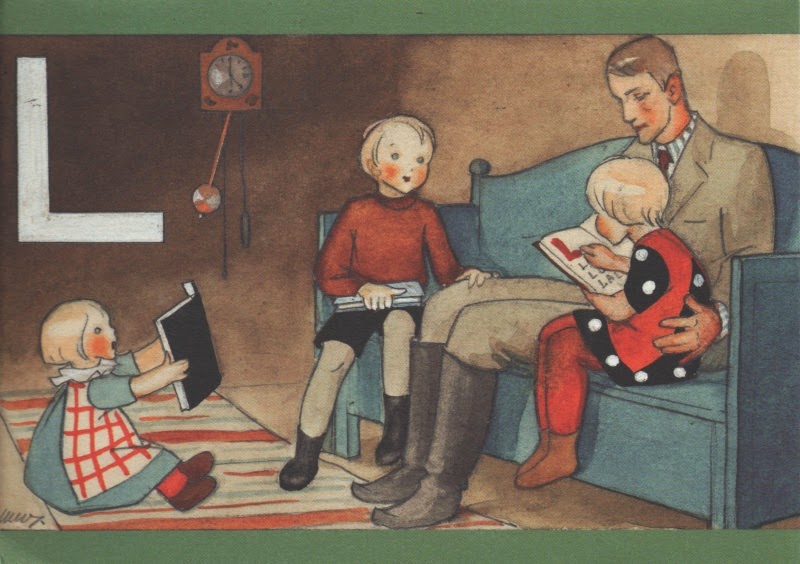
To be more accurate, L is for "lukea" which, in Finnish, means to read.
It is an illustration by Martta Wendelin (1893-1986), an artist from Finland who created postcards, magazine covers, and illustrated fairy tales. Her themes tended to be nostalgic and charming, a little romantic.
Labels:
A-Z,
Art,
Books/reading/libraries,
children,
Finland
Location:
Finland
Monday, 13 April 2015
K is for Korea
It's Monday and, on my self-imposed schedule, I should be showing a map card. However K map cards seem to be in short supply. I have none of Kentucky or Kansas, while I have already posted one map of Seoul in Korea and another ancient map of Goseong.
So here we have a postcard issued by Korea Post in 2008, along with a set of two stamps, each worth 250 won, illustrating the King Sejong Station Special. 2008 was the International Polar Year, hence the stamps.
The King Seong Station was established in the Antarctic in 1988, so it was also the 20th anniversary of its founding. There are 17 researchers all year long but during the "summer" months, the number rises to 60 to 70 people.
My son went to the Antarctic one summer four or five years ago and brought back some of the most amazing photos I have seen.
Labels:
A-Z,
Antarctic,
South Korea,
stamp
Location:
South Korea
Saturday, 11 April 2015
J is for Japan
Two cards sent to me from Japan, one recently, the other several years ago, and each sent by a different person. I don't even think they have the same publisher but what struck me was that they have a similar misty, unfocused, style.
The first shows an unnamed coastal village "somewhere in Japan" and the second pictures an old building in Hakodate, a historical city in north Japan. I believe it's the Old Public Hall.
Location:
Hakodate, Hokkaido Prefecture, Japan
Friday, 10 April 2015
I is for Irkutsk
I chose this card for two reasons. The first is that it's a building of a style that I've never seen before. On the back of the card it tells me that it's the Palace of Pioneers and Schoolchildren. It took quite a bit of research to find out more.
It was originally a mansion built in 1897 by Alexander Fedorovich Vtorov, but nowadays it is used for what I suppose you would call extra-curricular activities for children. Here they can enjoy woodwork, electronics, photography, play sports, sing in choirs, drama, music, painting, and other crafts. It is one of the more striking buildings in Irkutsk.
The second reason I chose it was for the Cyrillic script "Иркутск", Irkutsk. The script interests me to the extent that I started a very basic course of Russian last year. It takes me several seconds to spell out a word but it's very satisfying when I can.
Irkutsk is one of the largest cities in Siberia, which makes up 77% of the landmass of Russia. It is very near Lake Baikal, the deepest and largest lake in the world.
Location:
Irkutsk, Irkutsk Oblast, Russia
Thursday, 9 April 2015
H is for Hollywood, Houston and Honeymoon Island
A journey across the United States of America, from east to west.
I would think the majority of people would know both Hollywood and Houston, but Honeymoon Island? That one was new to me. It was apparently once known as Hog Island but the name changed when some honeymoon cabins were built on the Island. those cabins no longer exist, but the name remains.
Labels:
A-Z,
beach,
night view,
USA
Location:
Honeymoon Island, Dunedin, FL 34698, USA
Subscribe to:
Comments (Atom)